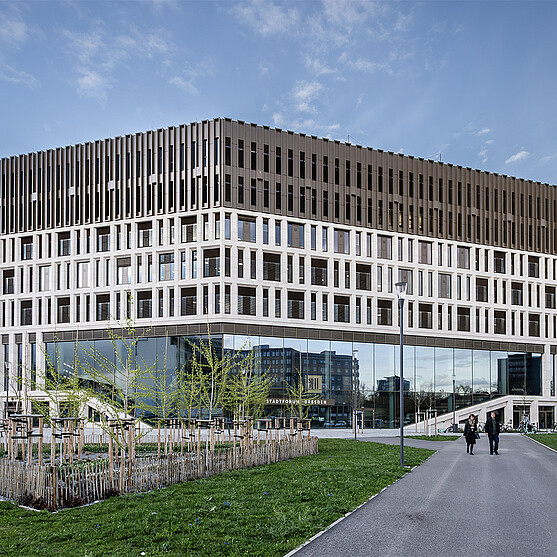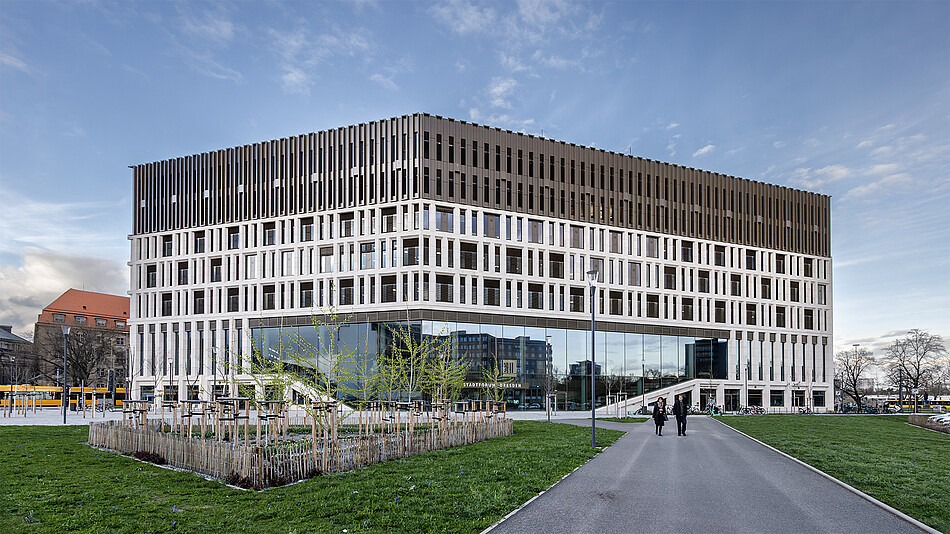
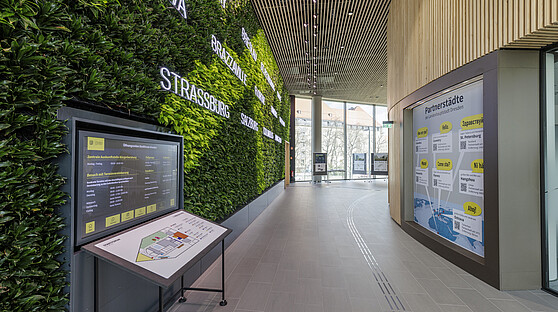
As one of the most modern administrative buildings in Saxony, the Stadtforum Dresden sets new standards for digital building technology and sustainable operations. With 20,500 square meters of floor space, this BNB Silver-certified government center brings together nine departments of the Saxon capital—including Urban Development, Building Construction, Environment, and Transportation—with approximately 1,500 employees under one roof. At the same time, the new building serves as an open forum for dialogue with citizens and underscores the city’s commitment to transparent, service-oriented administration. In addition to the light-filled entrance foyer with an open “Agora,” two landscaped courtyards create a spacious atmosphere.
Hidden in the background but of great importance for a high quality of stay, well-being, and healthy working conditions in all rooms is the smart building automation system from Kieback&Peter: The digital system coordinates the heating, air conditioning, and ventilation systems and ensures energy-optimized, sustainable, and climate-friendly operation around the clock.
Smart Building at the Stadtforum: Building Automation for the Perfect Indoor Climate in 250 Rooms
“The building management system for the Stadtforum was a very exciting project and one of the biggest technical challenges I’ve faced in my 30-year career,” says Frank Schumann. He is a sales engineer at the Kieback&Peter branch in Dresden, and over the course of a two-year construction period, he and his team integrated all of the building’s technical systems into a complex digital system.
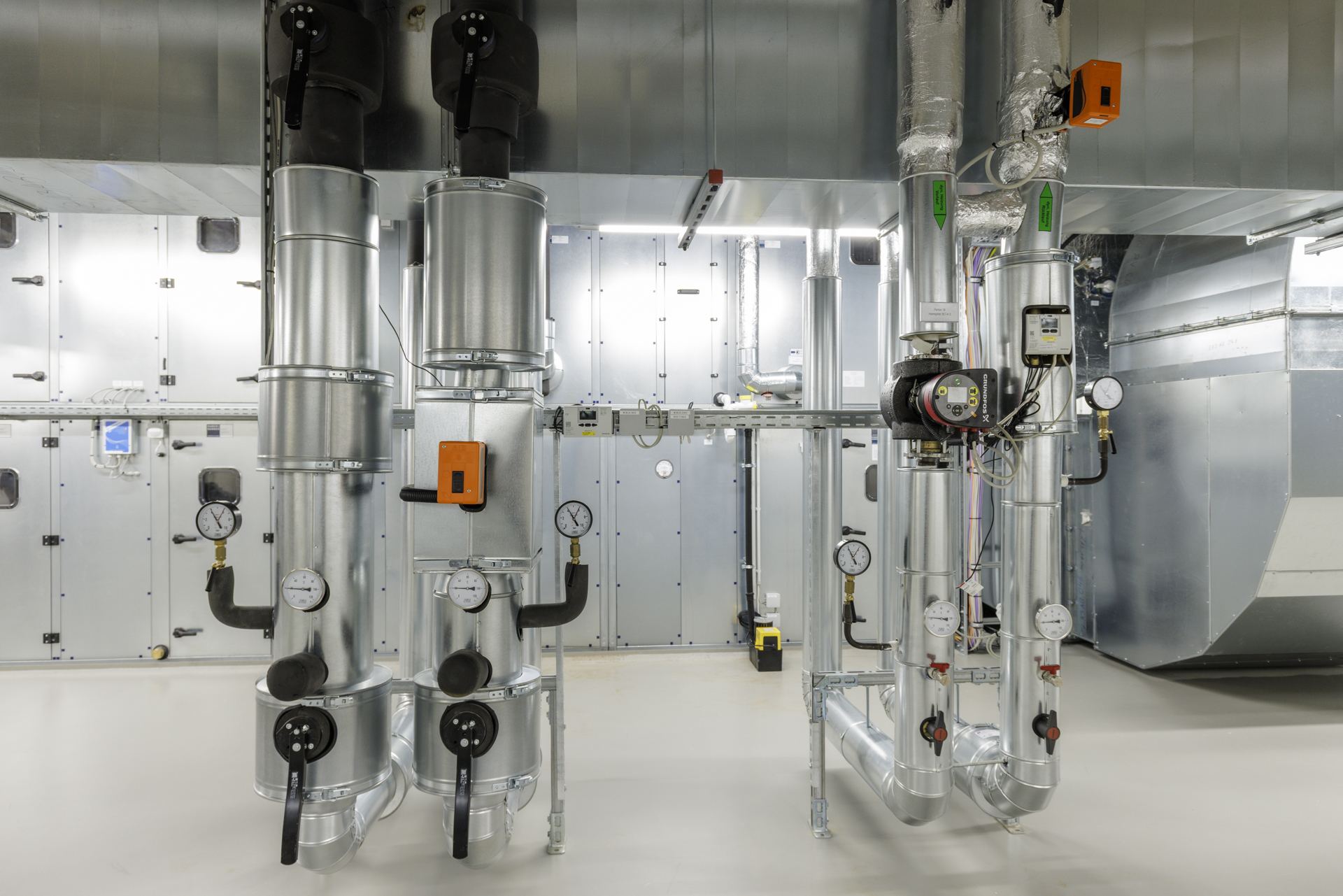
The system ensures that pleasant temperatures are maintained at all times and that the air remains “fresh” in the approximately 250 offices, conference rooms, meeting areas, the publicly accessible employee cafeteria, and the basement. To achieve this, the team networked approximately 7,000 technical components from various manufacturers using the BACnet communication protocol and connected them to Kieback&Peter’s high-performance DDC4000 controllers at automation hubs (ASP).
Using data from temperature, CO2, pressure, and airflow sensors, among other things, the intelligent system ensures that heating pumps, ventilation fans, and control valves automatically maintain the desired level of comfort at all times. It thus responds dynamically to changing usage patterns, ensuring optimal indoor conditions and air quality at all times. As a result, employees benefit from a consistently pleasant indoor climate that supports focused and productive work.
Significant cost savings thanks to actuators “Made in Germany”
Climate ceilings, which both heat and cool via water-filled panels, ensure comfortable temperatures throughout the administrative building all year round. Thanks to innovative 2-pipe technology, only half the system infrastructure is required compared to the usual 4-pipe system, resulting in a correspondingly lower investment cost for the building owner. This is made possible by the smart MD15 actuators manufactured in-house by Kieback&Peter in Mittenwalde. They can automatically perform hydraulic balancing, thereby regulating the appropriate flow rate for heating and cooling—and thus combining both functions in a single circuit.
Qanteon enables demand-based and energy-efficient room climate control
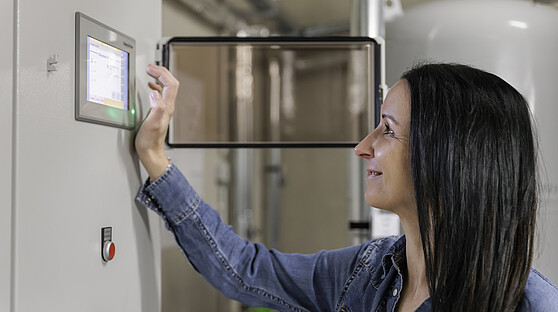
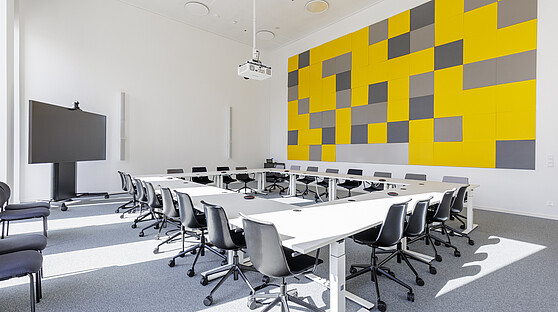
In addition to the two-wire technology, another technical detail stands out in the new Dresden Stadtforum. “We were tasked with designing and implementing a high-quality and highly sustainable building automation system—one that is as energy-efficient as possible,” explains project manager Silke Krug, citing the control of room temperature in the conference rooms as a particularly exciting component of the smart solution. It is linked to the administration’s electronic booking system via the Qanteon building management software. Ventilation and air conditioning only kick in automatically when the rooms are booked. A small component with a big impact on the resource-efficient operation of the Stadtforum.
The ventilation system also operates with extremely low emissions: it is controlled based on CO₂ levels and precisely adjusts fan output to match the actual occupancy of the rooms. “If there are only five people in a large conference room, only the corresponding amount of fresh air is supplied—instead of the full capacity for, say, 50 people,” explains Silke Krug. “This reduces energy consumption, conserves resources, and noticeably lowers the operating costs of an administrative building.”
Efficient coordination of trades in the new administrative building
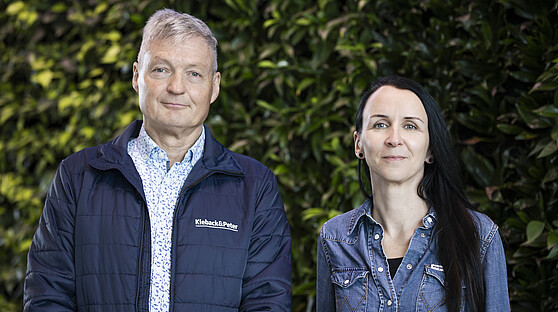
Large new construction projects are often characterized by tight schedules. It took about three years from the start of excavation to completion: construction spanned from January 2022 to March 2025. Close coordination among all trades was crucial to the project’s success.
“Project Manager Silke Krug, Systems Engineer Michael Singer, and the team at the Dresden branch planned and implemented the building automation system and seamlessly integrated it into the overall system. Today, we are pleased to see that the smart building concept is working smoothly and that Dresden has gained a modern, digitally connected administrative building,” concludes Frank Schumann.
![[Translate to Englisch:] Elbdeck Hamburg](/fileadmin/_processed_/9/b/csm_11_Deutschland_Hamburg_Elbdeck_c766930218.jpg "[Translate to Englisch:] Elbdeck")
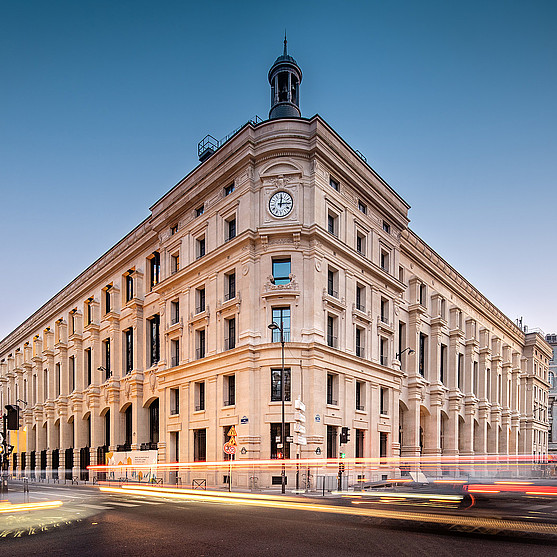
![[Translate to Englisch:] Qu4drans Paris](/fileadmin/_processed_/f/2/csm_Qu4drans_7e0a58bc67.jpg "[Translate to Englisch:] Qu4drans Paris")
![[Translate to Englisch:]](/fileadmin/_processed_/3/d/csm_L_T_Sporthaus_Osnabrueck_Indoor_kieback-peter_d47dda6a97.jpg "[Translate to Englisch:]")
![[Translate to Englisch:]](/fileadmin/_processed_/6/f/csm_flevo-krankenhaus-aussenansicht-kieback-peter_7f540b4b4f.jpg "[Translate to Englisch:]")
![[Translate to English:]](/fileadmin/_processed_/9/e/csm_roots-hamburg-referenz-detailansicht_02e0d87a86.jpg "[Translate to English:]")